HVAC Maintenance Orlando FL
Maintenance in Central Florida is not the same job as maintenance in a four-season climate. Systems here run far more hours, remove far more moisture, and sit outdoors in heat, rain and salt-laden air. The items that actually prevent breakdowns locally are drains, coils, airflow and electrical condition.
The purpose of a tune-up is to catch the failures that are predictable — a swelling capacitor, a slime-filled drain line, a coil losing heat transfer, a filter that has been in place since spring — before they become a no-cooling call in August.
What Florida maintenance should cover
Condensate drain and safety switches
Clearing the primary line, checking the trap, verifying the secondary pan and testing float switches. Biological growth builds fast in warm, humid conditions and drain clogs are a leading cause of shutdowns and water damage here.
Evaporator coil and filter
A dirty coil reduces capacity and dehumidification. Filters loaded with dust restrict airflow, which raises energy use and can freeze the coil.
Outdoor condenser coil
Grass clippings, pollen, dryer lint and vegetation reduce heat rejection, raise head pressure and shorten compressor life. Coils need clearance and periodic cleaning.
Electrical components
Capacitor capacitance, contactor condition, wire terminations and amp draws on the compressor and fan motors reveal parts nearing failure.
Refrigerant circuit
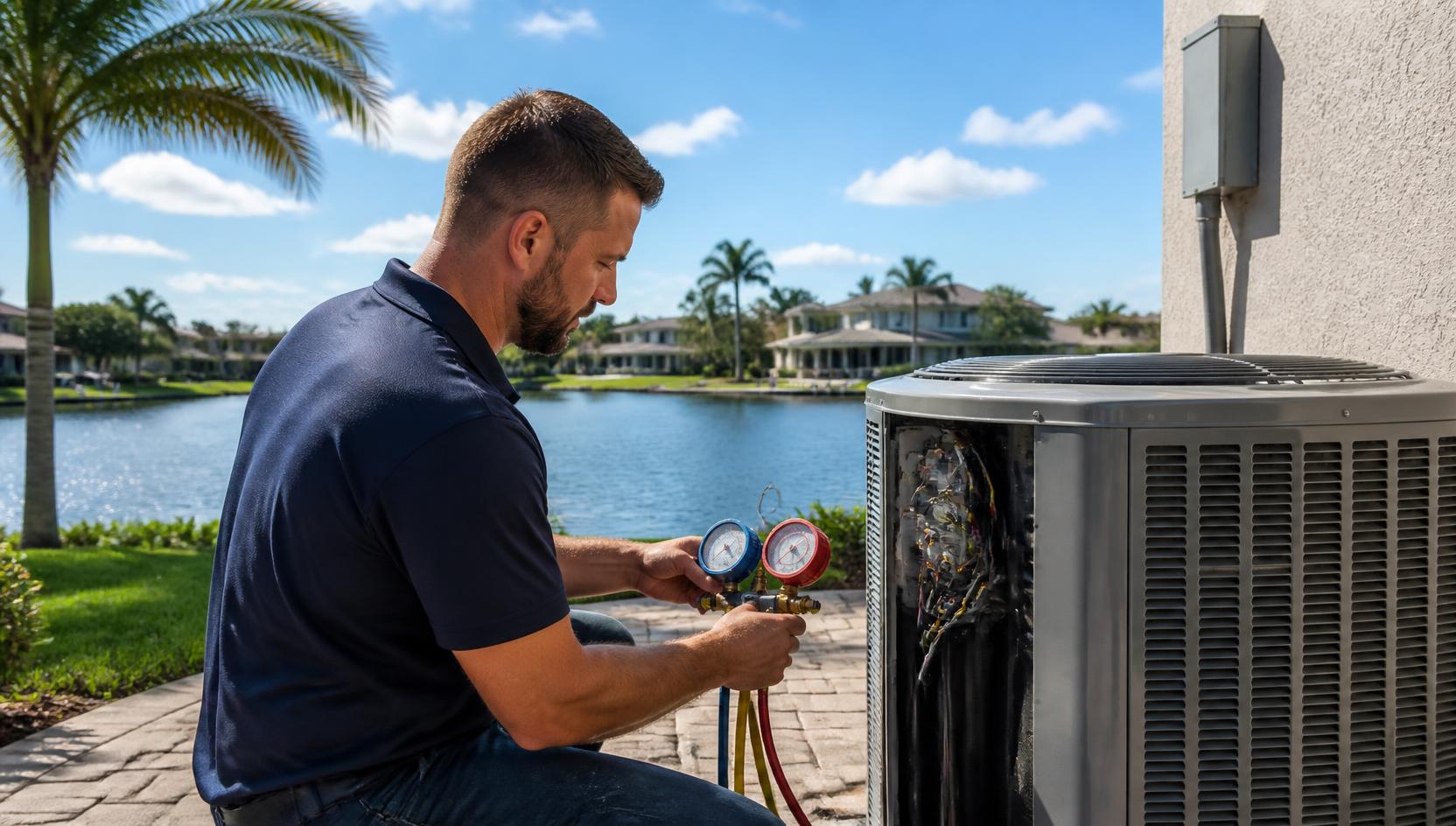
Pressures and temperatures checked by a qualified technician to confirm the system is operating within range; a charge that has drifted indicates a leak to locate rather than simply top up.
Airflow and static pressure
Blower operation, return condition and duct restrictions — the mechanical basis of both comfort and coil freezing.
Thermostat and controls
Verifying calibration, staging, fan settings, and heat-pump auxiliary heat behaviour so backup heat is not energizing unnecessarily.
How often, and when
Because the cooling season here is long, most Orlando systems benefit from service twice a year: once before the heavy cooling months, and once to check heat-side operation and clean up after the summer load. A single annual visit is better than none, and is best scheduled in spring.
Filters are a separate item. Depending on filter type, household dust, pets and construction, a one-inch filter often needs changing every 30–90 days; deeper media filters run longer. Checking monthly during peak cooling is a reasonable habit.
What maintenance genuinely prevents
Maintenance does not make equipment immortal, and it will not stop a random component failure. What it reliably does is remove the predictable causes: drain clogs, airflow restriction, coil fouling and degraded electrical parts, which together account for a large share of summer no-cooling calls.
It also creates a baseline. Recorded pressures, temperature split and amp draws from one visit to the next make gradual problems — a slow refrigerant leak, a motor drawing more current each year — visible while they are still cheap to address.
What homeowners can do between visits
Change filters on schedule
The single highest-value homeowner task; note the size and keep spares.
Keep the condenser clear
Maintain roughly two feet of clearance, trim shrubs, and rinse debris off the coil fins with a garden hose (not a pressure washer) with the power off at the disconnect.
Watch the drain
If you see water near the air handler or the system shuts down after running, suspect the condensate path.
Leave the fan on AUTO
Running the fan continuously in humid weather can re-evaporate moisture from the coil back into the house.
Set realistic setpoints
Very low setpoints during peak heat force long run times without improving dehumidification much.
HVAC Maintenance questions Orlando homeowners ask
How often should HVAC systems be serviced in Florida?
Does a tune-up lower my electric bill?
Why does my drain line keep clogging?
Do you sell maintenance plans?
More questions are answered on our Orlando HVAC FAQ and in the HVAC cost guide.
Need HVAC Service in Orlando?
Tell us what your heating or cooling system is doing and request service.