AC Installation Orlando FL
A good air conditioner installation is decided before any equipment arrives: correct sizing for the house, ductwork that can actually carry the airflow, a drain and pad detail suited to Florida, and controls matched to the equipment. Getting those right matters more to comfort and running cost than the badge on the condenser.
In Orlando the replacement conversation usually starts when a system is in its teens, has lost capacity, or has failed in a way that is expensive to repair. It is also the one moment where humidity control, duct leakage and airflow problems can be corrected at reasonable cost.
Sizing: bigger is not better in Florida
An oversized air conditioner cools the thermostat quickly and then shuts off, which leaves the indoor coil too little run time to pull moisture out of the air. The result is a house that reads 74°F and still feels damp, plus more start/stop wear on the compressor.
Sizing should be based on the building — square footage, orientation, window area and shading, insulation levels, ceiling height, duct location and infiltration — rather than simply matching the tonnage of the outgoing unit, which may itself have been wrong. Where an existing system has been chronically oversized or undersized, replacement is the time to correct it.
Efficiency and SEER2 in a long cooling season
SEER2 and EER2 ratings describe cooling efficiency under standardized test conditions. Because Orlando systems run so many hours a year, the difference between a baseline single-stage unit and a higher-efficiency two-stage or variable-speed system shows up in both energy use and comfort.
Variable-speed and two-stage equipment runs longer at lower capacity, which typically produces steadier temperatures and better moisture removal than a single-stage unit cycling on and off. Higher efficiency also carries higher equipment cost, so the comparison worth making is total installed cost against expected run hours, not headline rating alone.
Ductwork and airflow compatibility
Return capacity
Many older Orlando homes have undersized returns. A new higher-airflow system installed onto an inadequate return will be noisy and underperform regardless of equipment quality.
Attic duct condition
Flex duct that is crushed, disconnected, sagging or poorly insulated loses conditioned air into an attic that can exceed 120°F. Duct repairs are far easier to make while the system is out.
Static pressure
Measuring external static pressure before and after installation shows whether the duct system can carry the airflow the new equipment expects.
Register and room balance
Rooms that were always warm rarely fix themselves with new equipment; they usually need duct, damper or register changes made during the project.
Heat pump or straight-cool central AC?
In Central Florida a heat pump is a straightforward option because it uses the same refrigeration cycle for cooling and, in reverse, for the relatively modest heating demand. Straight-cool systems paired with electric resistance heat are also common, and both configurations are appropriate here.
The practical differences are heating efficiency during cool spells, equipment and control compatibility, and how the existing air handler is wired. If your home currently has electric strip heat only, replacing with a heat pump generally lowers heating energy use, and strip heat is retained as auxiliary backup.
What a well-run installation includes
Removal and recovery
Old refrigerant recovered per EPA rules and the existing equipment removed.
Line set handling
Evaluation of whether existing refrigerant lines can be reused, flushed, or must be replaced for the new refrigerant type.
Pad, clearances and drainage
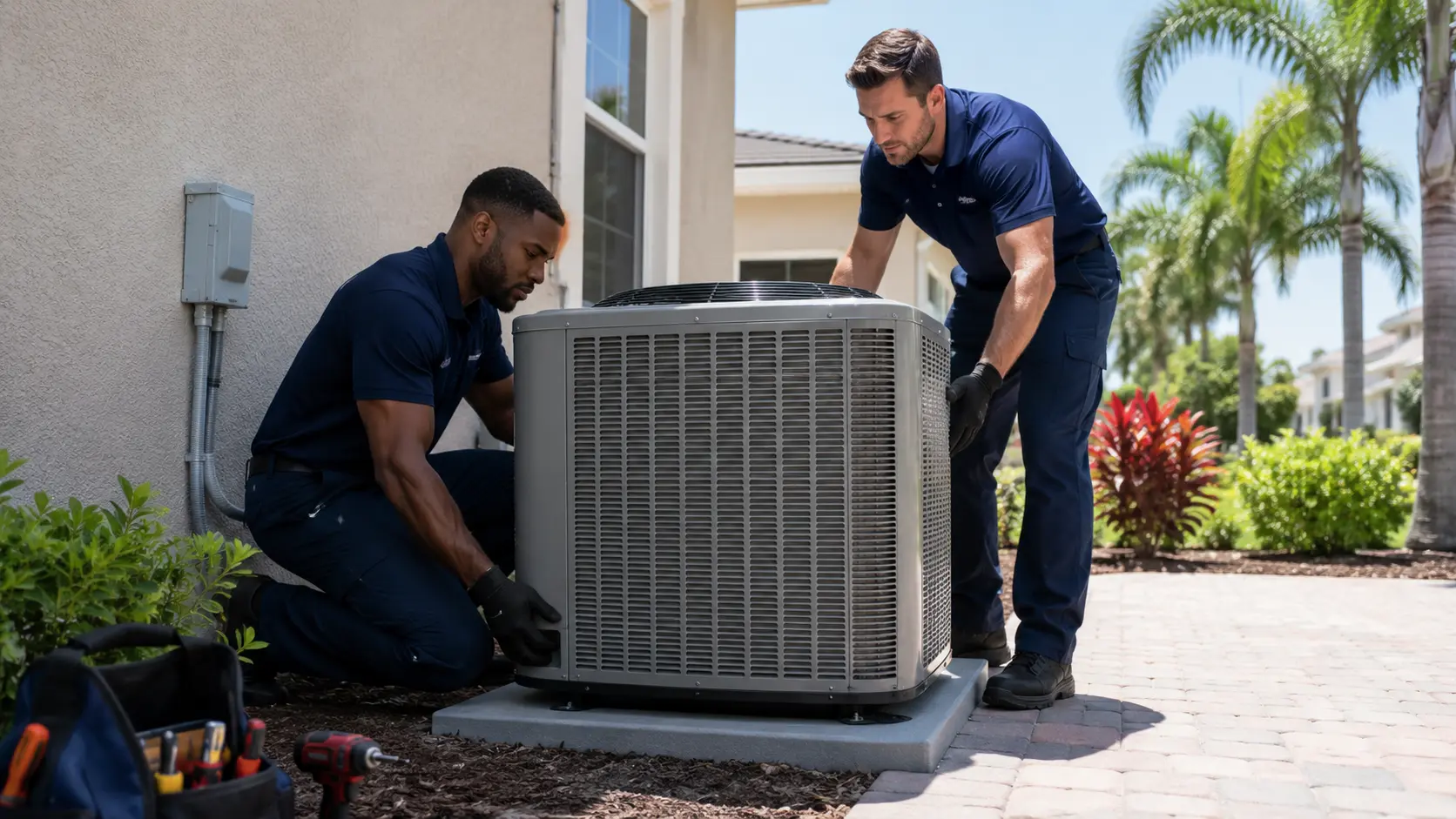
Level, elevated condenser mounting with clearance for airflow and service access, which matters during Florida storm season.
Condensate detail
Properly sloped primary drain, trap, secondary protection and float switch — the single most common source of avoidable indoor water damage here.
Evacuation and charge
Deep vacuum before start-up and charge verified by measurement, not by feel.
Controls and commissioning
Thermostat configured for the equipment type and staging, airflow set, and operating values documented at start-up.
Permits and planning
HVAC changeouts in the Orlando area are permitted work, and inspections cover items such as electrical disconnects, equipment mounting and condensate. Building a permit and inspection step into the project timeline avoids surprises, and matters if you sell the home later.
Plan the project rather than the emergency where possible. Replacing a struggling system in a planned window gives time to evaluate sizing, compare equipment options and address duct issues, instead of choosing under pressure during a July failure.
AC Installation questions Orlando homeowners ask
How long does an AC replacement take?
Can I reuse my existing ductwork?
Do I need the same tonnage as my old system?
What does SEER2 mean for my power bill?
More questions are answered on our Orlando HVAC FAQ and in the HVAC cost guide.
Need HVAC Service in Orlando?
Tell us what your heating or cooling system is doing and request service.